

The Real Cost of an AI Agent in 2026: US, UK & Gulf pricing, broken open
July 17, 2026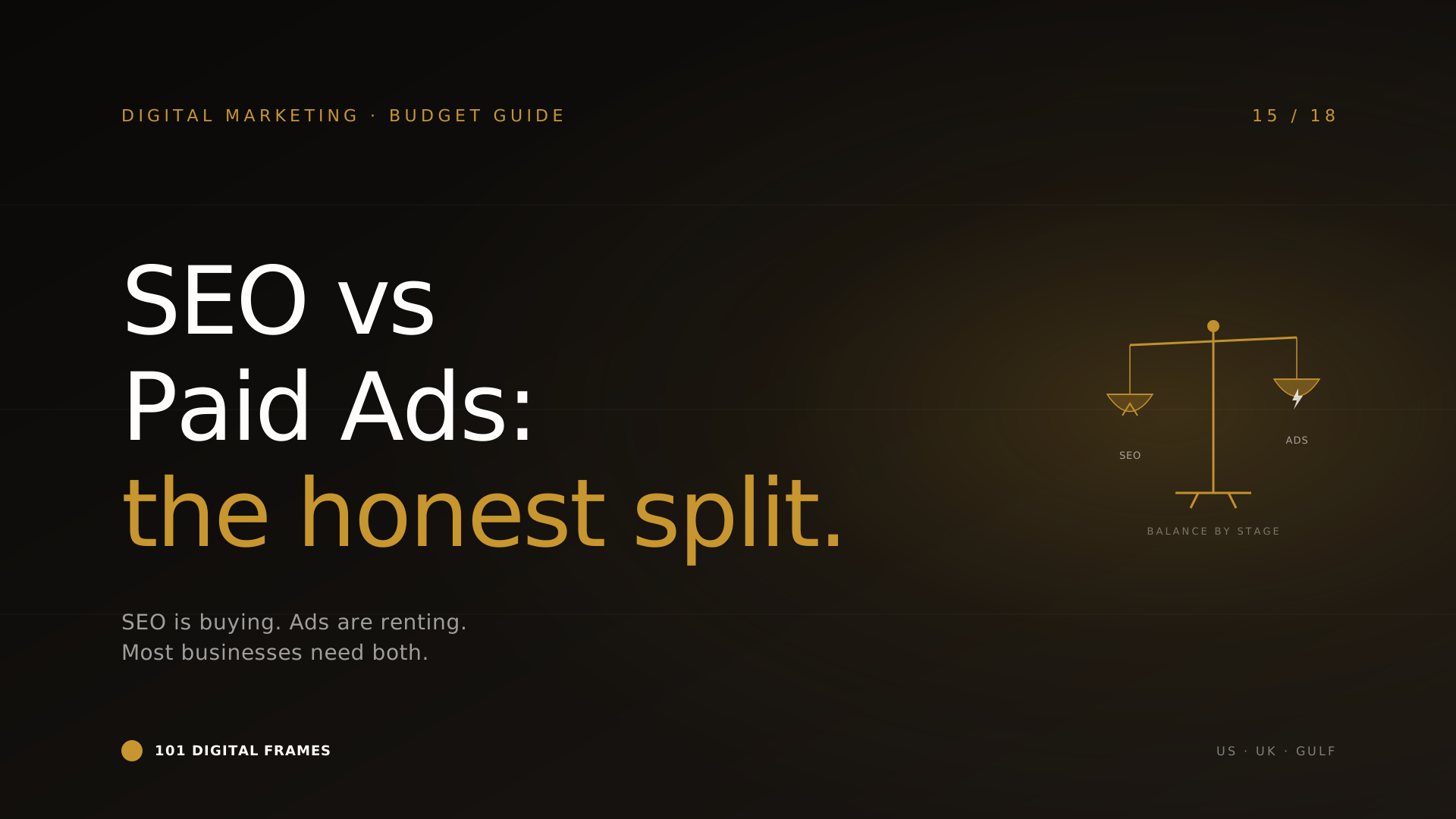
SEO vs Paid Ads in 2026: where should your budget actually go?
July 21, 2026The Real Cost of an AI Agent in 2026: US, UK & Gulf pricing, broken open
July 17, 2026SEO vs Paid Ads in 2026: where should your budget actually go?
July 21, 2026"How much should we spend on marketing?" gets answered two useless ways. Either a vague "it depends" that helps nobody, or a rigid "spend 10% of revenue" that ignores everything about your actual situation. The truth is in between — there are real benchmarks, and there's a real method for adjusting them to your business.
This article gives you both. What businesses genuinely spend in 2026 — by revenue percentage, by stage, and split across channels — and a simple framework to set your own number instead of guessing. Plus the budget-wasting mistakes we see most often, because how you spend matters at least as much as how much.
It pairs directly with our guide on SEO vs paid ads — that one tells you how to split the budget between channels; this one tells you how big the budget should be in the first place.
Let's start with the number everyone wants.
The percentage-of-revenue rule (and its limits)
The most-quoted benchmark: businesses spend roughly 7–12% of revenue on marketing, with growth-focused companies pushing toward 15–20% and established, coasting ones dropping to 5%. It's a useful starting anchor. It's also incomplete, for two reasons.
First, it's circular for new businesses. "Spend a percentage of revenue" is useless advice when you have little revenue yet. Early-stage businesses have to spend based on what they can afford and what they need to grow, not a slice of a number that's still small.
Second, it ignores margin. A software business with 80% margins can pour far more into marketing than a retailer running on 15%. The same revenue percentage means very different things depending on what's left after costs. Use the percentage as a sanity check, not a target — the method later in this article is more reliable.
What businesses actually spend, by stage
Realistic monthly ranges for SMBs in the US, UK, and Gulf, combining management and media spend. Figures in USD.
Media spend usually makes up the larger share as you scale; agency management is often 10–20% of media, or a flat retainer. Working with a team in a lower-cost market lowers the management portion without lowering the media that actually buys reach.
Tell us your revenue, margin, and goals. We'll suggest a realistic monthly number and where to put it.
Set your budget from goals, not guesswork
Instead of picking a percentage from the air, work backwards from what you want. It takes four numbers you already roughly know.
1. Your goal. "20 new customers a month." Start with the outcome, not the spend.
2. Your conversion rate. If 1 in 20 leads becomes a customer, 20 customers needs ~400 leads a month.
3. Your cost per lead. If a lead costs ~$15 to generate, 400 leads ≈ $6,000 in media.
4. Your customer value. If each customer is worth $500 and 20 of them is $10,000, spending $6,000 to earn $10,000 is healthy. If the maths inverts, the goal or the channel is wrong — not the budget.
This is the difference between marketing as a cost and marketing as an investment. When you know your numbers, the budget stops being a leap of faith — it becomes a calculation with a knowable return. Don't have these figures yet? Getting them is the first thing worth spending on.
If you know your cost per lead and customer value, we can build you a budget with a knowable return — not a hopeful guess.
What the budget actually gets spent on
"Marketing budget" isn't one thing. A healthy one is split across several jobs — and a common mistake is pouring everything into ads while starving the foundations that make ads work.
- →Paid media — the spend that buys clicks and impressions. Usually the largest share once you're scaling.
- →SEO & content — the compounding asset. Boring to fund, transformative over time.
- →Social & creative — the content that feeds every channel. Underfunding this makes everything else underperform.
- →Website & conversion — the destination. Sending paid traffic to a weak site wastes the media spend behind it.
- →Tools & management — analytics, automation, and the people or agency running it all.
The foundations — a site that converts and a brand that earns trust — aren't separate from your marketing budget. They're the multiplier on it. Great ads pointed at a weak website is the most common way businesses waste money in 2026.
Five ways businesses waste their marketing budget
1. No tracking. Spending without measuring which channels produce customers is spending blind. If you can't see what's working, you can't stop what isn't. This wastes more budget than any other single mistake.
2. Quitting too early. Pulling SEO or a new ad campaign after six weeks because it "isn't working" — before it's had time to. Marketing needs a runway. Judge channels on the right timeline, not on impatience.
3. All spend, no foundation. Pouring money into ads that point at a slow, unconvincing website. You're paying for clicks that were never going to convert. Fix the destination before you scale the traffic.
4. Spreading too thin. A small budget scattered across six channels does nothing well anywhere. Better to dominate one or two channels than to be invisible on all of them. Focus beats breadth at small budgets.
5. Confusing activity with results. Posting daily, running ads, sending emails — busy isn't the same as effective. Tie every activity back to a metric that matters. If it doesn't move a number you care about, question why you're funding it.
Right size, right channels, tracked from day one.
Free 30-minute call. We'll help you set a number that returns more than it costs — and show you how to prove it.
In one paragraph
The 7–12% of revenue benchmark is a useful sanity check but a poor target — it's circular for new businesses and blind to margin. A better method works backwards from your goal, conversion rate, cost per lead, and customer value, turning the budget from a guess into a calculation with a knowable return. Spend it across paid media, SEO, content, and the foundations — a converting website and a trusted brand — because great ads pointed at a weak site is how most budgets get wasted. Track everything, give channels a real runway, focus a small budget rather than scattering it, and judge every activity by a number that matters. Do that, and marketing stops being a cost you fear and becomes an investment you can prove.
Common questions
What percentage of revenue should go to marketing?+
A common benchmark is 7–12% of revenue, rising to 15–20% for businesses in aggressive growth mode and dropping to around 5% for established, coasting ones. But treat it as a sanity check, not a target — it ignores your margins and is circular for early-stage businesses. Setting the budget from your goals and unit economics is more reliable.
How much should a small business spend per month?+
Realistically, a just-launched business often starts at $500–$2,000/month, a growing small business at $2,000–$6,000, and an established SMB at $6,000–$20,000 — all combining management and media spend. The right figure depends far more on your margins, customer value, and growth goals than on any fixed rule.
How do I know if my marketing budget is working?+
Track two numbers above all: cost to acquire a customer (CAC) and the value of that customer (LTV). If you're spending less to acquire a customer than they're worth to you, it's working — scale it. If not, the goal, the channel, or the funnel needs fixing before you add budget. Without this tracking, you're guessing.
Should I hire an agency or build an in-house team?+
For most SMBs, an agency is more cost-effective until your monthly spend is large enough to justify full-time salaries — usually well into five figures a month. An agency gives you a whole team's range of skills for less than one senior hire. In-house makes sense once marketing is central enough to need daily, dedicated ownership.
Is it cheaper to work with an agency in a lower-cost market?+
For the management and creative portion, yes — often significantly. A serious agency operating with talent in a lower-cost market delivers the same strategy, content, and campaign management for less overhead, which means more of your budget goes to the media that actually buys reach rather than to office costs. The media spend itself costs the same wherever your agency sits.
Ready to set a budget that pays for itself?
Book a 30-minute call. Tell us your revenue, margins, and goals, and we'll help you set a realistic monthly number, split it across the right channels, and track it so you can prove the return. Global pricing, tracked from day one.
101 Digital Frames LLC · Florida, USA · Birmingham, UK · Muscat, Oman