
AI Workflow Automation for SMBs: 9 use cases that pay for themselves in 30 days
July 17, 2026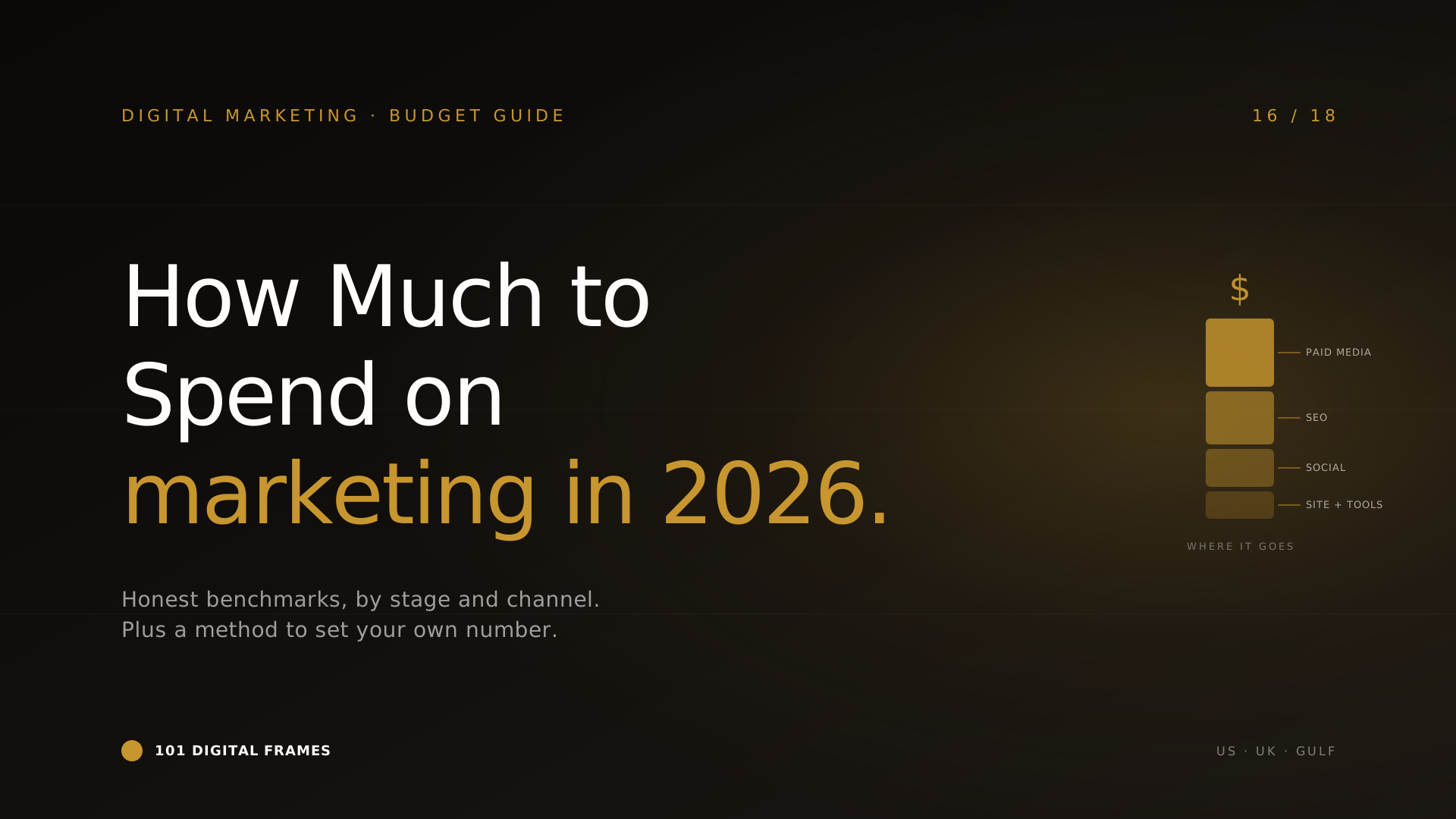
How Much Should You Spend on Digital Marketing in 2026?
July 21, 2026AI Workflow Automation for SMBs: 9 use cases that pay for themselves in 30 days
July 17, 2026How Much Should You Spend on Digital Marketing in 2026?
July 21, 2026Almost every quote we have seen from another AI agency hides at least one of three numbers: the model usage cost, the hosting cost, or the ongoing retainer. The build cost gets the spotlight; the rest gets buried.
Six months later you have spent twice what you expected and you have no idea where the money went.
This article fixes that. We are publishing the same ranges we use internally when scoping projects for our US, UK, and Gulf clients. All four cost layers. All the regional differences. All the factors that move the price up or down. By the end of this you will know whether the quote you are holding is fair, padded, or suspiciously cheap.
If you are still in the earlier part of the journey, our cornerstone piece on what an AI agency actually does, the agents vs chatbots vs automation breakdown, and the nine SMB use cases are worth reading first.
Every AI project has four cost layers
If a quote only itemises one of them, you are looking at half the picture.
Layer 1 · The build
The agency's labour to design, build, integrate, test, and deploy the system. Paid as a one-off, usually with milestone-based instalments.
Layer 2 · Model usage
What you pay OpenAI, Anthropic, Google, or your model provider per token used. Scales linearly with how heavily the system is used. Often the most under-estimated number in a proposal.
Layer 3 · Hosting & infrastructure
Vector databases, automation platforms (n8n, Make, Zapier), hosting (Vercel, AWS, Azure), monitoring tools, third-party APIs (Apollo, Clearbit, transcription services).
Layer 4 · Maintenance retainer
Ongoing prompt tuning, monitoring for drift, handling edge cases, updating when underlying models change. AI systems quietly degrade if no one is watching.
Send it to us. We'll tell you which layers are missing and what fair looks like.
Pricing by project type
All figures in USD. Build cost is one-off. Monthly is fully-loaded (model + hosting + retainer combined). Assumes typical SMB volume.
Ranges are for a single deliverable. Most clients run two or three of these concurrently, which usually attracts a 15–25% bundle discount from any reasonable agency.
How the same project prices across regions
Same scope, three different markets. The pattern below holds for almost every project type. Build costs vary by labour rate; model and hosting costs are largely identical worldwide.
"Global / Gulf" assumes an agency operating with offices or staff in lower-cost markets (Eastern Europe, South Asia, parts of LATAM, parts of MENA) while delivering to Western standards. This is how most cost-effective work gets done in 2026 — including at established US- and UK-headquartered firms.
Why the cheaper quote is sometimes the right one
There is a quiet snobbery in Western markets that a $40,000 quote must be better than a $15,000 one for the same scope. In 2026 it usually isn't.
The AI tooling has become democratised — the same OpenAI APIs, the same Pinecone vector databases, the same n8n nodes are available to a four-person agency in Lahore, Bucharest, or Lisbon as they are to a hundred-person agency in San Francisco. What you are paying for at the higher end is one of three things: the city the agency office is in, the brand on the proposal, or genuine depth of engineering experience. Only the third matters for the result.
A serious lower-cost agency will deliver to the same standard if you check the same things: portfolio with named outcomes, references you can call, a written scope, milestone-based payments, and ownership of the code and prompts after launch. The price tag is not a quality signal. The process is.
Where the cheap quote actually goes wrong is when it is cheap because the agency has not done it before, has not priced in the model usage, or has cut corners on the parts of the build you cannot see during a demo. Use the twelve questions to find out which kind of cheap you are looking at.
We're a US-incorporated agency with offices in Florida, the UK, and Oman. Our pricing sits in the "Global" column. The work sits in the "US agency" column.
Ten factors that change the price
Two clients asking for "an AI chatbot" can receive quotes that differ by 4x. These are the variables that explain almost all of that spread.
-
01
Number of integrations
Every CRM, ERP, or third-party tool connection adds 8–25 hours of build.
-
02
Volume of inputs the system will handle
1,000 documents per month is a different system than 1,000,000. Architecture costs scale, model costs scale, infra costs scale.
-
03
Compliance requirements
HIPAA, SOC 2, GDPR, UAE PDPL, Saudi PDPL — each one adds discovery, documentation, and architectural constraints. Easily 20–40% extra.
-
04
Data quality at the start
Clean documented data: cheap. Messy unstructured data scattered across systems: expect 30–60% extra in pre-processing work.
-
05
Multilingual or single-language
Adding Arabic, French, or Mandarin support to an English-first system adds 15–25% for the testing and fine-tuning required.
-
06
Real-time vs batch
A system that responds in under two seconds needs different (and pricier) infrastructure than one that runs overnight.
-
07
Custom UI vs embedded
A chatbot living inside your Intercom widget: cheap. A custom-designed conversational interface with bespoke UX: 2–3x more.
-
08
Model choice
GPT-4 class models cost 5–10x what GPT-3.5 / Claude Haiku / Gemini Flash cost per token. The right model for the task can move monthly bills by an order of magnitude.
-
09
Hosting choice
Deploying on your own AWS/Azure tenant (slower, more secure, more expensive) vs on the agency's shared infrastructure (faster, cheaper, less private).
-
10
Internal review cycles
Sounds soft, costs hard. A project signed off by one founder ships in 6 weeks. The same project with 8 internal stakeholders and a compliance committee takes 14.
Six pricing red flags in a proposal
- ×No itemised cost layers. One headline number with no breakdown of build vs model usage vs hosting vs retainer.
- ×Model usage marked "pass-through" or "TBD". This is the line that will surprise you in month 3. Insist on a projected monthly range based on your volume.
- ×Front-loaded payment terms. 80% or 100% upfront for a build that takes 8 weeks is not normal. Milestone-based payments are.
- ×"Custom enterprise pricing" with no number attached. Translation: they will work backwards from your budget rather than from your scope.
- ×Open-ended hourly billing on the build. Hourly is fine for retainer work after launch. For the initial build it punishes you for being decisive.
- ×Quotes that match to within 5%. If three independent agencies have quoted you almost identical numbers, they have priced each other rather than your project. Get a fourth quote.
All four layers itemised. Milestone payments. Zero gotchas.
Reply within 48 hours with a full scope, all four cost layers, and milestone-based payments. The format you should expect from any agency.
In one paragraph
An AI project has four cost layers — the build, the model usage, the hosting, the retainer — and any quote that hides one of them is hiding the real bill. Build cost scales with scope, integrations, compliance, and how much variation the system has to handle. The same project costs 30–50% less from a serious agency operating in a lower-cost market than from a US-headquartered firm, and the difference is the office, not the work. Use the four-layer model to compare quotes properly, the ten factors to understand why they differ, and the six red flags to spot the agency that is going to surprise you on invoice four.
Common questions
What's the cheapest AI project worth doing in 2026?+
Around $1,500. A targeted single-purpose automation — meeting notes to CRM, review monitoring, invoice extraction. Anything below that, you are better off building it yourself in Zapier or Make.
How much does model usage actually cost per month?+
Rough rule of thumb at 2026 pricing: a chatbot handling 1,000 customer conversations a month using GPT-4 class models costs $50–$150. A RAG system with 5,000 queries: $200–$500. A full lead-qualification agent doing research on 500 leads: $300–$800. Volume × token use × model tier.
Do I really need a monthly retainer after launch?+
For at least the first six months, yes. AI systems drift — prompts that worked perfectly at launch start producing weaker output as user behaviour changes, models get updated, or edge cases surface. After six months you can either bring it in-house or scale back to a smaller retainer.
Is it cheaper to use a no-code AI tool instead of hiring an agency?+
For the first project of a simple kind, sometimes yes. Tools like Zapier AI, n8n, and Lindy let an operator ship something useful in a few days. They start to break at the third or fourth integration, when edge cases pile up, and when you need a UI users actually enjoy. At that point an agency is usually faster and cheaper than continued DIY.
Why do US agencies charge so much more for the same work?+
Real estate, salaries, and brand premium. A senior AI engineer in San Francisco costs an agency $180k+ before benefits; the same talent in Lisbon, Bucharest, or Lahore costs $40–80k. Toolset and quality can be identical. Where US firms genuinely earn the premium is on regulated work (HIPAA, FedRAMP) and on stakeholder management for very large enterprises — neither of which applies to most SMB projects.
Should I pay in my local currency or USD?+
Pay in the currency the work is priced in. For most international AI agencies the work is priced in USD because that's how their model providers (OpenAI, Anthropic, Google) bill them. Forcing them to invoice you in GBP or AED usually adds a small FX-buffer markup. Pay USD direct via wire or Wise — cheaper for both sides.
Want a quote that itemises all four layers?
Tell us your use case in 30 minutes. We'll reply within 48 hours with build cost, projected model usage, hosting, and a retainer recommendation. No surprises on invoice four.
101 Digital Frames LLC · Florida, USA · Birmingham, UK · Muscat, Oman