
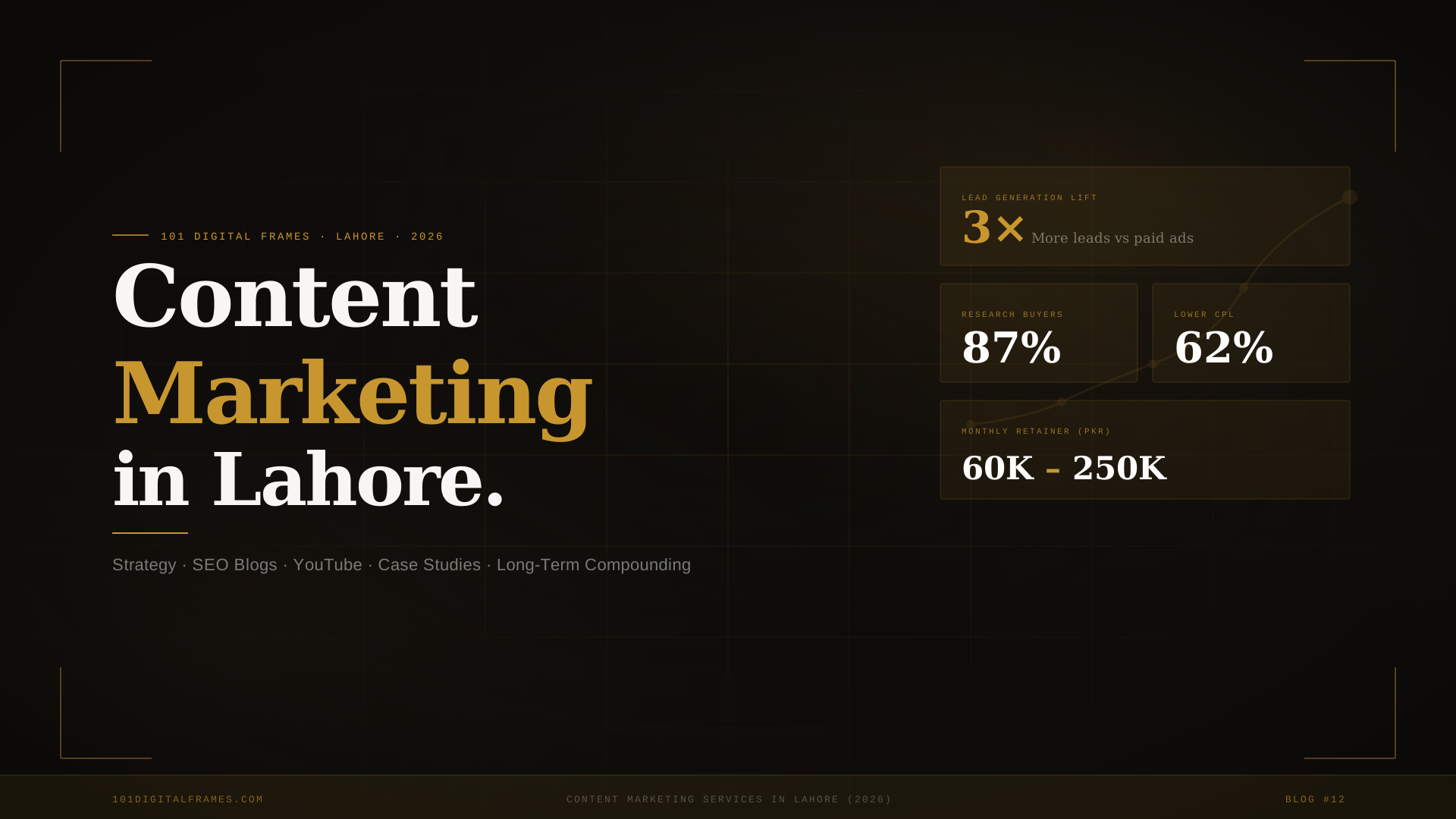
Content Marketing Services in Lahore: Complete Guide (2026)
June 9, 2026Ask ten people what an "AI agency" is and you will get ten different answers. Some will describe a marketing team that uses ChatGPT to write captions. Others will describe a software house that fine-tunes language models for the Fortune 500. Both are wrong, and both are right.
If you are a founder, a marketing lead, or an operator considering bringing in outside help for an AI project in 2026, that confusion costs you money. You end up either overpaying a consultancy for a 40-page strategy deck that ships nothing, or underpaying a freelancer who hands you a chatbot that breaks the first time a real customer talks to it.
This guide cuts through that. We will cover what a real AI agency does, the eight categories of work they actually deliver, the signals that tell you it is time to hire one, the signals that tell you it is not, what it should cost in the US, the UK, and the Gulf, and the questions you should ask before signing anything.
No fluff. Let us begin.
What an AI agency actually is
An AI agency builds and ships working AI systems inside your business. That is the whole definition. The keyword is ships. Not strategy decks. Not "AI readiness assessments." Working systems that your team uses on Monday morning to do something they could not do on Friday.
It is easier to define an AI agency by what it is not. There are three adjacent things people regularly confuse with one.
A marketing agency that "uses AI"
Every marketing agency in the world now claims to be AI-powered. Most of them just use ChatGPT to draft captions faster. That is fine. It is not an AI agency.
A software development shop
Dev shops build apps. Some of those apps happen to have an AI feature. They are excellent at writing code; they are usually weak at thinking through which automation will actually move your revenue numbers.
An AI consultancy
Big-name consultancies will sell you a strategy. A real AI agency sells you a working system. Both have a place. Only one ships software you can use.
A proper AI agency sits in the middle of those three. Strategic enough to pick the right problem. Technical enough to build the solution. Commercial enough to tie it back to your revenue, your support load, or your time saved.
The eight things an AI agency actually delivers
Here is the real menu of work in 2026. Most engagements involve two or three of these, not all eight.
Custom GPTs and internal AI assistants
A trained assistant that knows your products, your tone of voice, your SOPs, your pricing, your customers. Used internally by your team to draft proposals, answer policy questions, or onboard new hires.
AI agents (autonomous workflows)
The 2026 evolution of automation. A multi-step agent that can read an inbound lead, research the company, qualify it, schedule a meeting, and update your CRM. Without anyone touching it.
Workflow automation with AI nodes
Tools like n8n, Make, and Zapier with AI steps baked in. Less glamorous than agents, dramatically more reliable. This is where most real ROI happens — invoice processing, lead routing, content repurposing, report generation.
Customer-facing chatbots
Support, sales qualification, e-commerce concierge. The good ones know when to escalate to a human. The bad ones are the reason your customers hate chatbots in general.
RAG systems (chat with your documents)
Retrieval-augmented generation. Plug your contracts, your policy library, your engineering wiki, or your product catalogue into an AI that can answer questions from it accurately. The single most useful pattern in enterprise AI right now.
Voice AI and phone agents
Inbound and outbound voice agents that book appointments, qualify leads, or handle tier-one support over the phone. The technology crossed the believability line in 2025 and is now the fastest-growing category.
Content production pipelines
SEO content, social media output, email sequences, ad creative. Not "ChatGPT writes a blog." Structured pipelines that turn a single brief into thirty assets with consistent brand voice and human-quality output.
Custom integrations and infrastructure
The unglamorous foundation. Connecting AI to your CRM, your ERP, your e-commerce platform, your support desk. This is where projects succeed or quietly die.
Tell us your problem in 30 minutes — we'll tell you which of these eight actually solves it.
When you actually need an AI agency
Most businesses do not need one yet, and the agencies that tell you otherwise are selling you something. Here are the honest signals that you do.
- → A repetitive process is eating more than ten hours per week of your team's time, and it has a clear, documentable structure.
- → Customer support response times are slipping and hiring more agents has stopped helping.
- → Your sales pipeline is leaking because nobody is following up with inbound leads inside the first ten minutes.
- → Your content team has hit a wall — they can write good things, but they cannot produce the volume your channels demand.
- → You have personally tried to get ChatGPT or Claude to handle a workflow and it almost works, but it is not reliable enough to trust.
- → You bought an off-the-shelf AI tool, you pay every month, and your team does not actually use it because it does not fit how you work.
When you do not need one (yet)
Equally important. The wrong time to hire an AI agency is more common than the right time.
Your process is not documented. If a human on your team cannot explain the workflow start to finish, AI will not figure it out for you. Document first. Automate second.
The pain is under five hours a week. You will spend more time briefing the agency than you will save. Live with it.
Nobody on your team will own it. Every AI project needs a human champion on your side. Without one, the system gets built, the agency hands it over, nobody uses it, and the subscription quietly bleeds money.
You are hoping AI will fix a strategy problem. If you do not know who your customer is, AI will help you ignore them faster. Get the strategy right first.
If your process is documented, your team has a champion, and you've found a workflow worth automating — we should talk.
How to evaluate an AI agency before you hire
Seven questions worth asking in a discovery call. The answers tell you everything.
-
01
"Walk me through your last three AI projects."
If they cannot describe three specific shipped systems with measurable outcomes, they are still learning on someone else's budget.
-
02
"What happens if the AI gets it wrong?"
Good agencies think about hallucination, escalation paths, human review checkpoints, and failure modes. Weak ones promise it will not happen.
-
03
"Who owns the system after launch?"
You should own the prompts, the data pipeline, the credentials, and the code. If they will not commit to that, walk away.
-
04
"What's the ongoing monthly cost after build?"
Model usage. Hosting. Maintenance. Any agency that quotes you a build cost without a clear monthly run-rate is hiding the real number.
-
05
"How do you handle our data?"
Especially critical for UK clients (GDPR), US clients in regulated industries, and Gulf clients with data residency rules in the UAE and KSA. The answer should be specific, not "we take privacy seriously."
-
06
"Can I talk to two of your past clients?"
If the answer is yes within 24 hours, you are talking to a real agency. If it takes a week and you only get one warm reference, you are not.
-
07
"What would make you turn this project down?"
An agency that has never said no to a brief has no taste. You want the one with opinions.
What it should cost in 2026
Honest ranges for a single AI engagement, by region and scope. Prices in USD.
Note: these ranges exclude model usage costs (OpenAI, Anthropic, Google), which typically run $50 – $2,000+ per month depending on volume.
Get a fixed-scope quote in 48 hours.
Share your use case — we'll reply with a scope, timeline and price. No sales theatre.
In one paragraph
An AI agency builds and ships working AI systems inside your business — agents, chatbots, automations, RAG tools, voice — that save your team time or earn your business money. You need one when you have a documented, repetitive process eating real hours, a champion on your team, and a willingness to own the result after launch. You do not need one when you are using AI as a substitute for strategy, when your process is not yet defined, or when nobody on your side will use the thing.
Pick the right project. Pick the right partner. Ship the work. Measure the outcome. That is the whole job.
Common questions
What's the difference between an AI agency and a marketing agency?+
A marketing agency runs your marketing. An AI agency builds the AI systems that run inside your business — many of which are not marketing at all. There is overlap (AI-driven content production, ad creative automation), but the core work is different. Marketing agencies sell campaigns; AI agencies sell working systems.
Can a small business afford an AI agency in 2026?+
Yes. Starter automations begin at around $3,000 and pay back inside 60 to 90 days for most service businesses. The myth that AI is enterprise-only died in 2024. The most ROI-positive AI projects we see in 2026 are at companies with 5 to 50 employees, not 5,000.
How long does an AI project actually take?+
A starter automation: 2 to 4 weeks. A mid-scope chatbot or agent: 6 to 10 weeks. A full RAG or multi-agent system with integrations: 3 to 6 months. The single biggest delay is always the same — getting clean data and documented processes from the client.
Will AI replace my team?+
The best AI projects do not replace people. They remove the work your people hate doing so they can spend time on the work they were hired for. Replacement is usually a signal that you bought a tool, not a system.
Do we own the AI system after the project ends?+
With a good agency, yes — you own the prompts, the data, the workflow definitions, and the credentials. Some agencies build systems on proprietary platforms and effectively hold you hostage. Always confirm ownership in writing before signing.
Which AI model should my business use — ChatGPT, Claude, or Gemini?+
The answer is almost always "more than one." Claude is currently the strongest for nuanced writing and reasoning. GPT models are strongest for tool use and integrations. Gemini is strongest for multimodal and Google Workspace work. A good AI agency picks the right model for each task rather than forcing one provider on you.
Have an AI project in mind?
We build AI agents, chatbots, automations and RAG systems for clients across the US, UK and Gulf. Book a 30-minute call — no pitch, just an honest read on whether your project is ready.
101 Digital Frames LLC · Florida, USA · Birmingham, UK · Muscat, Oman